


 "M$ hates Free Software of any kind," asserted blogger Robert Pogson. "They have attacked Linux, the GPL, copyleft, etc. -- stuff that would be of no interest to them at all except their customers see the advantages of Free Software. What the world does with Linux, the GPL and copyleft is the world's business, not M$'s. We should not do any more than allow M$ to use Free Software if they want."
Those of us who have been around the block a few times here in the Linux blogosphere have seen it many times before: With one hand, Microsoft (Nasdaq: MSFT) holds out a small olive branch to the Linux community, while with the other it prepares a new patent attack, posts a "cautionary" FUD-filled video, or perpetrates some other kind of anti-FOSS mischief.
That's why it felt like deja vu all over again last week, when we learned not only that Microsoft is apparently one of the top contributors to the Linux kernel, but also that it had sent an early birthday present to Linux in the form of an apparently lighthearted video.
'Microsoft and Linux?'
Featuring cartoon versions of Bill Gates and Tux, the video begins by recounting the "rocky start" the two experienced, including the famous Halloween Documents exchanged among Microsoft executives about Linux and the "bickering" that continues today.
Also shown is Tux throwing a rock at Gates' "window."
"There's no truce in sight," the video reads... "Or is there?"
The final line then concludes by changing the text "Microsoft vs. Linux?" to "Microsoft and Linux?" followed by birthday wishes.
Is it conciliatory? Is it touching? Is it passive-aggressive? Linux bloggers have been struggling to decide.
'Pigs Still Don't Fly'
"Is it time to start trusting Microsoft?" was the title of an open ballot over on TuxRadar, for example, and respondents weren't shy with their opinions.
"No way!" exclaimed kaaposc, for instance. "Remember, pigs still don't fly."
"Nope," agreed mfraser. "Under no circumstances should we start trusting them, they are still trying to use their patent portfolio to extract money from companies making Android phones."
'I Needed a Good Laugh'
On the other hand, "they can be trusted... sort of," countered Vredfreak.
"Microsoft can be trusted to do one thing: whatever it takes to make money," Vredfreak added. "For years they accomplished it by simply exercising its monopoly on the desktop space. There are too many avenues open for this to work anymore, so they have to find new strategies, mainly patent trolling and the appearance of integration and cooperation with competitors."
Then again, "trust Microsoft?" wrote reup. "wharfff wharfff wharfff ! Cool, I needed a good laugh today."
TuxRadar's post was soon followed by a two-part series on OStatic (here and here) on much the same topic, so it quickly became clear the topic was gaining momentum.
Linux Girl took to the heavily air-conditioned Broken Windows Lounge to learn more. Was the birthday video a genuine gesture -- or just one more Machiavellian maneuver?
'They Need to Quit with the Lawsuits'
"It really did seem conciliatory, especially when they referenced some of their own contributions to the hostility, such as the Halloween Documents," consultant and Slashdot blogger Gerhard Mack told Linux Girl.
Still, "if they really want to make peace, they need to quit with the patent threats and lawsuits," Mack added.
Others took a stronger view.
'Nothing But a Series of Lies'
"Passive-aggressive doesn't begin to cover it," Hyperlogos blogger Martin Espinoza told Linux Girl, for example.
"The first hostility in the video is a penguin (Tux?) throwing a rock at a Windows-logo window with Bill Gates behind it, followed by Microsoft trying to 'scare' Linux 'at Halloween,'" Espinoza explained. "This is immediately followed by the assertion that Microsoft found Linux's ideas 'childish,' which directly contradicts the stance of the Halloween Documents, which prove that Microsoft saw Linux as a threat."
Chronologically, "this video is nothing but a series of lies presented to make Microsoft look like the good guy, which could not possibly be further from the truth," Espinoza concluded.
'The Thin Edge of the Wedge'
Indeed, "M$ hates Free Software of any kind," blogger Robert Pogson agreed. "They have attacked Linux, the GPL, copyleft, etc. -- stuff that would be of no interest to them at all except their customers see the advantages of Free Software.
"What the world does with Linux, the GPL and copyleft is the world's business, not M$'s," Pogson added. "We should not do any more than allow M$ to use Free Software if they want."
Accepting any kind of offering from Microsoft is "the thin edge of the wedge," Pogson cautioned. "Their hypervisor is of value to M$'s customers and it does not hurt freedom to have M$'s customers using GNU/Linux. We should, however, also promote and improve KVM, which is pretty cool."
Finally, "for any who think M$ is just a business competing in the real world on price/performance," Pogson offered the following reminders:
" M$ paid UUNET Pipex, an ISP, big bucks to ship Internet Exploder so as to cut Netscape out of the market";
"M$ has a deliberate policy of shortening the life of PCs to maximize revenue"; and
"M$ charges different prices for essentially the same technology."
A 'Tarnished' Reputation
Chris Travers, a Slashdot blogger who works on the LedgerSMB project, had a more measured outlook.
"What's going on here is that Linux has become deeply embedded in the server market," Travers told Linux Girl.
That, in turn, has created two problems for Microsoft, he suggested.
"First, they have invested a LOT of effort trying to keep that from happening," he pointed out. "This has reduced their credibility regarding further attacks on Linux."
Second, however, is that while it's getting better, "Microsoft has not been the best at interop in the past," Travers added. "This too has tarnished their reputation."
Bottom line? "What I think Microsoft is trying to do here is make an about-face to undo the embarrassment that they are facing."
'Why Would the Community Care?'
Last but not least, Slashdot blogger hairyfeet answered Linux Girl's question with another question: "Why would the Linux community care one way or the other?"
The fact that it does indicates a "serious problem" in the Linux community, hairyfeet suggested: "the community fixates on the last war instead of trying to plan for the next one.
"Want to see the most likely future for MSFT in 15 years? Look at IBM (NYSE: IBM) now," he asserted. "Once upon a time everyone was scared of old 'big blue' -- nobody dared to try to mess with the big dog. Now? Just another company -- a big company, but just a company."
'Say Thanks and Move On'
Microsoft will likely "rule the desktop" for as long as there is one, hairyfeet opined, "but more and more of people's lives are being held off of the desktop, in tablets and phones."
Rather than adapt to that new market, meanwhile, Microsoft "shows their 'I don't understand my customers' problem by putting Windows 8 on everything, including ARM (Nasdaq: ARMHY), instead of focusing on making winPhone a top notch OS," he said. "They are gonna royally burn their customers."
So why should the community care about the video birthday greetings?
Hairyfeet's advice: "Just say 'gee thanks' and move on."
 Until Google puts in place a clear customer service organization, make sure you keep a copy of your stuff on your own hardware. This is likely good advice for any online service. Google really needs to start focusing on customer satisfaction, though. Its current perceived position of "hey, it's free -- take what we give you" isn't likely going to work in the long term.
 Android Honeycomb, the version of the mobile OS built specifically for tablet devices, was first rolled out many months ago. Several Honeycomb tablets are on store shelves. Yet the number of Android apps built specifically for Honeycomb remains relatively small compared to the tens of thousands of iPad apps Apple claims. What's the holdup?
 The expanding role of 10 GbE in cloud computing environments is the bigger story here. Intel's Xeon CPUs play critical roles in the vast majority of cloud and hyper-scale computing infrastructures and are critically important to cloud service providers of every sort. The company is also working closely with cloud storage vendors to enhance performance and efficiency.
 A new project has taken root at the Mozilla Foundation to create a new mobile OS called "Gecko." The Boot to Gecko project aims to create a mobile OS based on the Android kernel that would use the Web to displace proprietary, single-vendor stacks for app development. It's been compared to Google Chrome OS, only for mobile devices instead of laptops.
 Is curation the end result of the analytics phase? That implies analytics is all that's important. But thinking from a pure analytics perspective might simply put us into a different box. curation is not part of the analytics cascade and is, I believe, on the spectrum between qualitative and emotional. Think of curation as the kind of analytics that only a human mind can achieve.
 Eqonomize's approach to its GUI makes it more than a mere checking and savings account ledger. The drop-down menus, tool bar and action panel make a click-and-view style natural and efficient. Despite a few missing features, Equonomize takes the sweat and toil out of personal bookkeeping and banking tasks.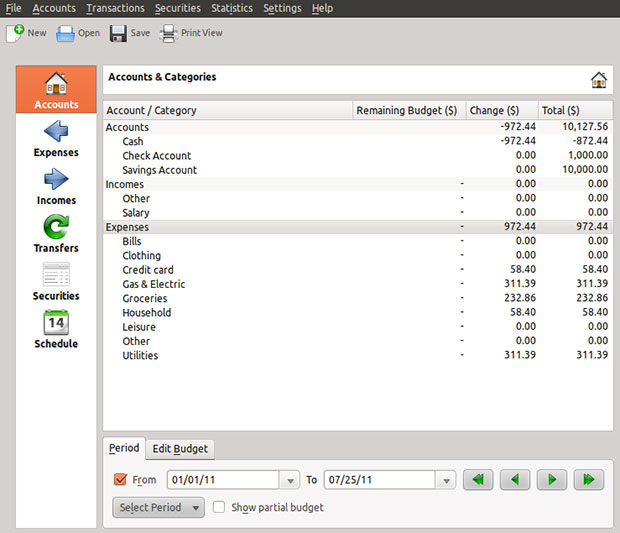
 Microsoft has released Mango to handset manufacturers. The new update to Redmond's Windows Phone 7 mobile operating system features new multitasking abilities, threaded communications systems, and a mobile version of Internet Explorer 9. It's a sizable update for the young OS, but will it be enough to help Microsoft catch up to Android and iOS?
 The new Mac mini lacks an optical drive, as does the MacBook Air, which now holds the role of Apple's entry-level MacBook. Is the DVD drive headed the way of the 3.5-inch floppy drive? With all the content available online, from movies to software to music, most consumers probably won't miss the death of the plastic platter ... that is, unless ISPs begin changing the ways they do business.
 The Open Cloud Initiative made its debut at OSCON this week. The organization is set up to provide a common set of standards cloud providers can adhere to in order to let clients know their clouds are easy to migrate into and out of. Open cloud systems must represent all user data and metadata in open standard formats and expose all functionality through open standard interfaces.
 Apple's battling Android tablets in Europe, winning an injunction in a German court that bars Samsung from importing its Galaxy tab into most of the continent. The timing couldn't be worse for Samsung -- even if it manages to change the court's mind, its European launch of the device has already been hindered. Meanwhile, Kindle goes webby, Symbian says goodbye to North America, and Anonymous is not unanimous.
