Showing posts with label Computers. Show all posts

Sunday, September 18, 2011

Computing » Apple Could Deliver a September Surprise With New MBPs

Posted by echa 10:32 AM, under | No comments

Apple Could Deliver a September Surprise With New MBPs | Apple It was only last February that Apple rolled out its current line of MacBook Pros, but a recent report suggests it's getting ready for another refresh as soon as this month. The notebook bump would allegedly be relatively minor, adding slightly faster processors and not much else. But it could be just enough to give Apple yet another blowout holiday sales season.

Apple's (Nasdaq: AAPL) MacBook Pro laptop was upgraded with new Intel (Nasdaq: INTC) processors a little more than six months ago, but another refresh may be in the works that will bring revamped models to the shelves within the next two weeks.

The move is believed to be necessary to keep Apple's laptop up to date with Intel's latest Sandy Bridge quad-core processors.

Citing anonymous sources, AppleInsider reported Tuesday that the refresh will deliver marginal speed bumps to the laptop's performance. Other than that, no material changes over existing models will be ushered in with the update, according to the report.

The existing lineup of Intel processors in the MacBook Pro, which run at 2.0, 2.2 and 2.3 GHz, will be replaced with new Core i7 chips running at 2.4, 2.5 and 2.7 GHz, it stated.

Apple did not respond to a request for comment by MacNewsWorld on the rumored introduction.

Avoiding Consumer Regret

Hours after the AppleInsider report appeared, Decide.com -- a price-watching service that uses a number of data-mining and predictive technologies to make recommendations to consumers so they can make better purchasing decisions -- posted a "wait" warning for the MacBook Pro.

To arrive at a purchasing recommendation, Decide gathers news and rumors from thousands of sources across the Web and analyzes them with proprietary algorithms, explained the company's CEO Mike Fridgen.

"As those rumors for a particular product hit a critical mass, our editors will see that and change our recommendations from buys to waits," he told MacNewsWorld. "In the case of the MacBook Pro, we've just hit that point. It's gotten to a point where we believe now that a consumer would have regrets if they purchased a current version of the product."

Predictable Introductions

How much regret, however, may be debatable.

For most consumers, the difference between 2.2 and 2.4 GHz isn't going to be noticeable, asserted Carl Howe, research director for the Yankee Group in Boston. "It just makes people feel like they're not buying last year's technology," he told MacNewsWorld.

Although a jump from 2.0 to 2.4 gigahertz is significant, he conceded, "most people won't really pay very much attention to it."

"These machines are fast enough that most consumers don't tax them," he added.

Howe, who has studied Apple's introduction patterns over time, wouldn't be surprised if the company did a late-fall refresh of the line. "Apple introductions are remarkably predictable because of the sheer pacing of the market," he argued. "So, for instance, they very rarely do a Pro refresh in Q4 because they're refreshing all their consumer products just before Q4."

However, "Every now again they break the rule," he conceded, "and this sounds like it might be one of those. Although if they're going to break the rule, they usually do it as a minor update.

"Faster processor, yes," he added. "New case and design, no."

Blowout Holiday Numbers

The speed at which this latest refresh may be taking place could reflect Apple feeling market heat to push out new products faster. While six months between refreshes may seem fast in the Apple world, it isn't in the PC world, where the average refresh is three times a year, observed Stephen Baker, an analyst for the NPD Group.

"Apple hasn't had that fast a cadence, but clearly there's demand from the markeplace to turn over products faster than Apple has traditionally done," he told MacNewsWorld.

He contended that now is good time as any for a MacBook Pro refresh. "You're after back-to-school and you're ahead of the holiday season," he said.

In addition, because Apple had such outstanding fourth quarter sales last year, it will be difficult to surpass that performance this year, he continued. A refresh, even a small one, of a major product line may be just what it needs to keep pace with last year's numbers.

"They'd like to have some blowout holiday numbers this season, and upgrading and refreshing on the Mac, because it doesn't happen all that often, tends to be a great driver of volume for them," he said.

Sunday, September 11, 2011

Computing » FSF's Star Turn in the Android FUDathon, Part 2

Posted by echa 12:07 AM, under | No comments

Computing » FSF's Star Turn in the Android FUDathon, Part 2 The people and companies ... who disregard the Internet "don't be a dick" rule ... need more incentive to comply. However, even they don't lose the right to use the code permanently unless they decide to "be a dick" permanently. In those cases, it doesn't matter how many copies of the code they get -- each new license for each new copy would be terminated as soon as they attempted distribution outside the terms of the license.

FSF's Star Turn in the Android FUDathon, Part 1

Mr. Smith was kind enough to reply two days later.

Hi Barbara,


Thanks for your feedback. I've responded to some your specific points below.


I'm aware that a license change in Linux would require significant effort. However, that doesn't mean it can't or shouldn't be done. I wish it was easier for them, but we think they stand to benefit from upgrading even in this current situation.


You're right to point out that most parties that enforce the GPL are happy to let violators continue distributing during the compliance process. The article itself makes this same point, even explicitly observing that -- to the best of our knowledge -- the copyright holders of Linux follow this policy. I agree that this is an important consideration for companies that are considering using or distributing Linux, which is why I spent a whole paragraph on it.


At the same time, GPLv2 section 4 says what it says: when you violate the license, you immediately and permanently lose the rights it grants you. Saying so is not implying something false; it's stating plain fact. We don't like this. If we could go back in time and change it to use GPLv3's termination policies, we would. Unfortunately, we can't. And so it's fair to point out that, while the legal risks of using or distributing Linux are already very low, they could be reduced even further if it upgraded to GPLv3.


The people spreading FUD about Linux have seized on this one small true fact to make much more outlandish claims. We disagree with them about almost everything, but we're not going to let the fact that they're saying this one true thing cower us from saying it too. I feel confident that open-minded readers will understand the distinction between what we're saying and what they're saying.


Best regards,


Brett Smith
License Compliance Engineer, Free Software Foundation

My follow-up the same day --

Hi:


Thanks for your reply.


There are two issues, one being the difference between past non-compliance and current and future compliance.


The way I read it, non-compliance terminates the license, as per clause 4. Any code or product containing code during the non-compliant period is a problem, and needs to be fixed or begged forgiveness or whatever.


However, that is a separate issue from the question of whether someone can, in the future, obtain a new license under clause 6 with a new copy of the software, and abide by the new license instance. After all, it is a license, not a contract.


Example: TV manufacturer ships TVs without the source for busybox, and doesn't extend an offer for the source of busybox to buyers. They have breached the GPL, and the products are without question infringing. Obtaining a new license doesn't "fix" those non-compliant products -- that has to be negotiated with the license holder.


However, for future shipments, clause 6 allows them to obtain a new license for future shipments by downloading a new copy of busybox, and complying with the license. The text is quite clear -- each time you receive a copy of the program, you receive a license from the licensor, and no further limitations beyond the license can be applied. So, if the TV manufacturer is currently in compliance (they now distribute the source and/or make it available for 3 years to everyone who buys a TV), they have that right.


What they don't have a right to do is claim that their previous TVs are in compliance retroactively. The new instance of the license only covers the new copy of the code, not the old one, for which the license has been terminated. No "white-washing" of previous infractions without the agreement of the licensor, because that instance of the code was distributed without complying with the license that was granted with it, and as such, violates the licensors copyrights.


They could be forced to recall all those TVs, since they didn't have a license to distribute copies of that instance of the code, or they could negotiate some other settlement ... but that doesn't affect their current status with the new copy of the code and the new license grant. Attempting to void the new license instance when they are in full compliance with it is an attempt to impose additional conditions.


Now, if they are still not in compliance after they get the new copy of the code and start distributing, their license is once again terminated, so there is no question of them just downloading 1,000 copies of the code and trying to distribute 1,000 tvs that are out of compliance, so this is not some "loophole."


Additionally, they can't just say that because the new code is identical to the old code, that the new license covers the old code -- it does not. They would have to physically replace the old code with the new code -- kind of expensive if it's burned into rom, even if we ignore the substantial costs of shipping ... so the incentive would be to negotiate a settlement, as per current practice.


The important thing is that a license is not a contract. You're free to have multiple licenses, one per copy (I have several separately licensed copies of a commercial compiler, for example). If one of those copies one day falls into non-compliance, I don't lose my rights to the use of the other copies, since there is no contract -- the grant of a license is strictly one-way, from them to me. I'm either in compliance with the license wrt that individual copy, or I am not.


IF it were some volume license contract, that would be a different case, but that would be a single license instance that would cover multiple copies. Then, the right to use all copies COULD be terminated when the single license is terminated for non-compliance. But even then, issuing a new license and new copies, allows the new copies to be used. What happens with the old copies? Unless the licensor agrees to relicense them, they can't be used, since they are not licensed.


Under the GPLv2 section 6, each copy automatically comes with a license, which makes things both more complicated and simpler at the same time.


Most infringements fall into one of several categories:


accidental infringement -- example: the server went down so they are not currently honouring their committment to make the source available;


stupidity or honest mistakes -- example: a build script was reverted to an older version, and included the wrong source tree in a shipping product;


greed -- example: someone intentionally didn't comply with the license


For the first two, most people would agree that "stuff happens" and not demand that they be lined up against the wall and shot, or the software equivalent -- permanently revoking their right to use the code. A simple and honest apology when it is brought to their attention, and an offer to immediately get to work fixing the problem going forward and remediating past problems by, for example, getting a copy of the right source into everyone's hands who got the wrong version, is what most would see as more than reasonable.


It's just the people and companies in example 3, who disregard the Internet "don't be a dick" rule, who need more incentive to comply. However, even they don't lose the right to use the code permanently unless they decide to "be a dick" permanently. In those cases, it doesn't matter how many copies of the code they get -- each new license for each new copy would be terminated as soon as they attempted distribution outside the terms of the license. They're the ones that would, in effect, be permanently terminating their rights.


How does this all apply to Android?


Well, first, the attempt to get manufacturers to put pressure on linux to switch to the GPLv3 because of the non-existent threat of a permanent loss of rights under the GPLv2 license, even if they conform in the future and get a new license grant when they get a new copy of the code, is ill-advised.


Phones need to be licensed by the FCC in the US, and other bodies elsewhere. This means that they must provide reasonably provable guarantees to the FCC (or other) that they will operate within the parameters of the law. Different countries have different rules regarding the number of frequencies that phones can operate at, as well as power levels and behaviour when the phone receives a signal to terminate a call. Manufacturers control this using code that is (hopefully) protected from end-user tampering, often to the point of running it on a separate cpu, because it's simpler, cheaper, and less buggy than making 100 different versions for 200 different countries.


Switching Linux to the GPLv3 would render making any sort of demonstration of the manufacturer being able to enforce compliance with FCC rules impossible. That would make Linux toxic to phone manufacturers, who would quickly switch to a *BSD kernel (I wouldn't be surprised if a certain company doesn't have that waiting in the wings "just in case" -- it would be foolish not to, and it wouldn't be all that hard). Forget the FCC -- just the legal liabilities of phone manufacturers to mobile operators if they ship such easily-broken phones would kill any thought of using Linux on phones and tablets. They don't want cracked devices compromising their network's usability.


One further note: Section 5 of the GPLv2 is inaccurate when it states "However, nothing else grants you permission to modify or distribute the Program or its derivative works. These actions are prohibited by law if you do not accept this License." Sections of the program that are non-copyrightable can be used in derivative works. There is nothing to prevent someone from stripping out all copyrightable sections of the program and distributing the result, and doing so without even the original copyright notice (since there is no copyrighted material in it).


The same mistake occurs in the GPLv3 license, sections 5 and 9, and the AGPLv3 license, sections 5 and 9, wrt modifying a copyrighted work and then distributing it.


We saw this play out in the "Linux headers" dust-up. Copyright only protects copyrightable subject matter, and copyright law, not any license grant, gives the right to strip out all copyrightable material and then redistribute the result.


Licensing kind of reminds me of the quote "The more complicated they make the plumbing, the easier it is to stop up the drain." I've always been a fan of the old Borland "like a book" license for its simplicity and ease of understanding, but that's a whole other kettle of fish.


Some things to think about, no?


TTYL


Barbara Hudson

Please note that when I wrote "a license is not a contract," I did so only in the sense that it's not an agreement negotiated between parties. Also, the question of whether old code needs to be replaced if it's byte-for-byte identical actually isn't that simple -- it hinges on whether code is fungible -- a different can of worms that I felt would be more of a distraction at this stage.

More than a week has gone by with no further response. Read into it what you will.

Saturday, September 10, 2011

Computing » BleachBit Leaves Your File System Sparkling and Grime-Free

Posted by echa 11:59 PM, under | No comments

Computing » BleachBit Leaves Your File System Sparkling and Grime-Free Different Linux distros build in favorite cleaning products. For instance, Ubuntu has Computer Janitor. CentOS, Fedora and Red Hat Linux use Yum Clean to remove cached package data. But BleachBit goes beyond such distro-specific cleaning services to accomplish a more complete spit-and-polish session to Linux's file structure in any distro.

One of the most essential computer maintenance tasks is pruning outdated and orphaned files from the deep, dark dungeons within the Linux filing system. These disconnected scraps and bits are endemic to the file structure in any operating system, Linux included.

Weeding the Linux software garden is not something that typical users do often enough. However, letting the clutter of different temporary or cache folders linger will sooner or later slow down the system and waste valuable disk space. Taking out the digital trash fermenting in your Linux file system can be challenge-free, though, if you use the right cleaner package. One app that I have grown to love for its ease-of-use and thoroughness is BleachBit.

BleachBit
BleachBit

Unlike less rigorous cleaner apps, BleachBit removes files that could pose security risks. This removes the need for you to employ yet another product to finish cleaning out the clutter collection. For instance, it removes browsing histories and cookies planted to keep tabs on your website activities. It also shreds files to hide their contents. This helps to prevent others from recovering your deleted data.

Critical Missions

One key function in BleachBit raises my comfort level for computer security considerably. It does an outstanding job of wiping clean more than 90 applications. It cleans out their refuse but leaves their functionality intact.

For example, BleachBit takes the cleaning cloth to my often-used and favorite Linux staples. These programs include my list of installed Web brosers -- Firefox, Seamonkey, Google (Nasdaq: GOOG) Chrome and Opera. In fact, I have yet to find an app I regularly use that is not treated by one of BleachBit's installed cleaners. This includes Adobe (Nasdaq: ADBE) Flash, Audacious, Bash, Gedit, GIMP, Nautilus, Rythmbox and Skype.

BleachBit's usefulness does not end with its superior file deleting capabilities. It also wipes free disk space, thus hiding traces of files deleted by other applications. I also like being able to use its command line interface (CLI) to script automated cleaning sessions.

Bounteous Benefits

BleachBit can be invaluable in less obvious ways. For example, it is a virtual time and space saver if you run an encryption application for added file security. It can better prepare the file system for disk image compression to do ghosted backups or to maintain virtual machines. This general cleaning process frees up disk space. It also reduces the size and time needed for backups by eliminating unnecessary files.

Different Linux distros build in favorite cleaning products. For instance, Ubuntu has Computer Janitor. CentOS, Fedora and Red Hat (NYSE: RHT) Linux use Yum Clean to remove cached package data. Debian-based Linux systems such as Ubuntu, Kubuntu, Xubuntu and Linux Mint can use Clean APT to tidy up.

BleachBit goes beyond such distro-specific cleaning services to accomplish a more complete spit-and-polish session to Linux's file structure in any distro. I've been very pleased with its doggedness in finding widely-scatted junk such as Thumbs.db and .DS_Store files. It also excels in finding and removing broken shortcuts and deleting volumes of Linux localizations -- you know, all of those bulky language files you that are not your native language.

Clean and Simple

BleachBit does such a good job that I would be willing to tolerate a less-than-adequate interface. But that is not a trade-off I need to make, fortunately. BleachBit's look and feel is just as clean as the job it does cleaning out your computer's hard drive.

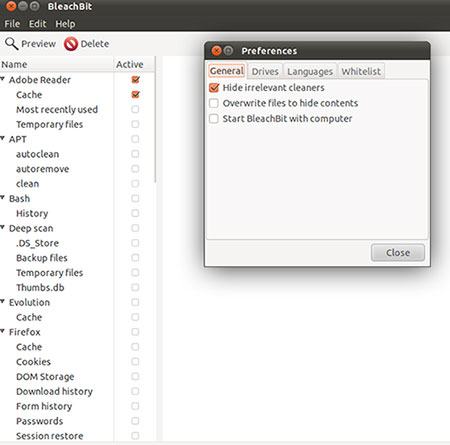
The File menu gets to the point quickly. Just select these options: Shred Files, Shred Folders or Wipe Free Space. Each of these options opens a file manager style picker window. Select the items you want cleaned.

A final choice in the File menu is Shred Settings and Quit. This last choice lets you reset your cleaning options. It closes the application. The next time you run BleachBit, the Preferences panel opens. Otherwise, you can always access the preferences panel from the Edit menu. You cannot miss it. Nothing else clutters the Edit menu.

The Set Up

There's nothing about BleachBit to scare away hesitant users. Its Graphical User Interface (GUI) is designed for simplicity, so newbies and Linux pros alike have a level playing field. All guesswork and Linux jargon are already wiped from the app.

From the General Tab, you can choose to hide irrelevant cleaners or overwrite files to hide their contents and start the app when the computer boots. Click the Drives Tab to Add/Remove the folders from each selected drive on the computer for which you want to overwrite free space. The Languages Tab lists all of the installed language support files. Check the ones that you do NOT want removed.

The Whitelist is a superb safety-net feature. Use it to add/remove files and folders that you do not want deleted or modified by BleachBit.

The Cleanup

Other than making a few choices in the the Preferences panel, the only other configuration BleachBit needs is a check list of cleaners to engage. This is another area in which BleachBit excels.

Highlight each item in the left column. A short, simple summary of what that cleaner does displays in the right column of the BleachBit app window. If the function will take a long time to complete, a warning box will pop open to tell you. The same thing happens with any other advisories connected to that function that might have other linked options.

These warnings are key to a safe system clean-out. Do not ignore the warning pop-ups. Some of the warnings alert you to potentially damaging results. So make sure before you proceed. A safer approach is to cancel that particular action and do some checking. You can always select that removal option in a later session.

When you are finished selected files and folders, you can click the Preview button below the menu row at the top of the app window. This reviews your choices and the actions you specified. Or, when you are ready to throw out the garbage bits, click on the Delete button next to Preview.

That's all there is to it. Did I say BleachBit was quick and simple?

Bottom Line

BleachBit is a powerful file-cleaning detergent. It works well with relative ease. But using it carelessly can have worse results than tossing bleach into a washing machine filled with colorful clothes. It comes with no Undo command.

It might be a bit too easy at times to remove too much. Almost no documentation is included. Before you attempt to use it, be sure to access the online how-to videos and documents. You can access these through the Help menu.

I use BleachBit on all of my desktop and laptop computers. I have yet to have a problem with cleaning out too much. But to be sure, I have system-level backup files available for each computer. I also have restore images for each computer stored on an external hard drive.

Computing » Which Linux Distro Leads the Pack?

Posted by echa 11:54 PM, under | No comments

Computing » Which Linux Distro Leads the Pack? "Debian is No. 1? Why am I not surprised," said Roberto Lim, a lawyer and blogger on Mobile Raptor. "Sometimes I really feel like the Linux community, which used to be about innovation and building the best next thing, has lost touch with society and are in danger of becoming irrelevant." The real No. 1 distro is Ubuntu, Lim asserted: "It is the only one with a shot at becoming more than a niche in a niche market."

Between Googlerola, the tempestuous software patent storm, HP's (NYSE: HPQ) shenanigans and the one-two punch delivered by CmdrTaco and Steve Jobs, we've surely displayed all the stamina any group of completely overwhelmed souls could reasonably be expected to have.

Time now for a little fun.

And how do Linux bloggers have fun? That's right, by engaging in a little high-spirited debate -- not of some weighty, industry-changing subject this time, though, but of a matter very close to all of our hearts. It's time, in other words, to ask the question once again: Which distro is best?

'The Best Linux Distro of 2011!'

It is with deepest gratitude to the ever-awesome geeks over at TuxRadar that Linux Girl calls your attention, dear readers, to a wonderfully thorough side-by-side comparison they recently performed on six of today's most popular Linux distributions: Fedora, Mint, Arch, Ubuntu, Debian and OpenSUSE.

"There are a lot of things to weigh up, and a lot of distros to plop on the scales, so if you wanted to compare them yourself, you would have to spend at least two weeks of little sleep and mind-poundingly painful headaches to draw up some kind of summary of how they measure up," the TuxRadar team wrote. "But don't bother, because here's one we prepared earlier. With diagrams and charts."

Installation, hardware support, desktop, customization, community, performance, package management and security were all among the features considered and compared in the six Linux distros. The results are summed up in a post from last month entitled, "The best Linux distro of 2011!"

Debian Is Crowned

Think it's all just another glorified ad for Ubuntu? Think again, because Ubuntu didn't win the No. 1 spot overall -- Debian did.

The result? More than 100 comments from Linux fans eager to agree with or dispute some or all of TuxRadar's results.

Linux Girl couldn't resist collecting her own small sampling of opinions.

'The Universal Operating System'

"Best distro? Of course, it's Debian GNU/Linux, the universal operating system," opined blogger and educator Robert Pogson.

"I stayed away from it for years because people told me it was 'hard' to install," Pogson recounted. "Last year, I gave all my high school students a quick demonstration, and they were all able to install Debian GNU/Linux and brought new life to the old PCs of the school. They even replaced XP on some hot, brand-new units. They loved it."

Besides its ease of installation and use, "Debian GNU/Linux has a great package manager with powerful tools to help find software in the huge repository and to install it easily to one or many PCs," Pogson noted. "Our school had a tiny pipe to the Internet, so we used APT's caching to make a server for the school so we could install at 10 MB/s. It was awesome.

"Bug tracking, dependency based booting, strict adherence to reasonable policies, releasing when it's ready... it goes on and on," Pogson concluded. "Debian GNU/Linux is a great distro. Try it. You'll like it."

'In Danger of Becoming Irrelevant'

Of course, here on the Linux blogs, there's always room for debate.

"Debian is No. 1? Why am I not surprised," retorted Roberto Lim, a lawyer and blogger on Mobile Raptor. "Sometimes I really feel like the Linux community, which used to be about innovation and building the best next thing, has lost touch with society and are in danger of becoming irrelevant."

The real No. 1 distro is Ubuntu, Lim asserted: "It is the only one with a shot at becoming more than a niche in a niche market."

'They Will Get Pushed Aside'

Then again: "Ubuntu has stumbled lately," opined consultant and Slashdot blogger Gerhard Mack.

"With its emphasis on tablets, they have forgotten about the desktops," Mack explained. "Now the competitors are building on the lessons learned from Ubuntu's rise and leapfrogging them now that they are fading. If they don't correct themselves they will get pushed aside."

Of course, "the fact that this happens so easily is what makes Linux great," Mack added.

'You'd Have to Be a Nut'

Hyperlogos blogger Martin Espinoza took issue with TuxRadar's inclusion of Fedora.

"Putting Fedora at the top of a 'best distributions' list is like putting a prototype car at the top of a list of cars to buy this year," Espinoza told Linux Girl.

"Fedora is the alpha test version for RHEL," he explained. "They break things there first. You'd have to be a nut to run it on a production system (though apparently, many people do) because the entire purpose of Fedora is to permit Red Hat (NYSE: RHT) to try new things and break stuff."

'A Good Distro That Deserves Mention'

Slashdot blogger hairyfeet recommended Vector Linux.

"They have SEVEN different versions, from SOHO to mini live, and with the exception of being a PITB to set up wireless, it is actually pretty nice," hairyfeet said.

The software is laptop-friendly, "only takes up 3GB, uses a nice XFCE, gives you plenty of software, all in all a good distro that deserves mention," hairyfeet concluded. "Oh and it is based on Slax so it isn't just another Debian ripoff."

'People Want Choice'

For Barbara Hudson, a blogger on Slashdot who goes by "Tom" on the site, it's all good.

"I keep hearing these calls for 'Linux unification' and 'one distribution to rule them all' and 'unifying the desktop,' but this survey reinforces the 'choice is good' mantra -- people *want* choice," Hudson told Linux Girl.

"It also shows the benefits of open competition," she added. "When every distro is free to use their competitors' code, the way to acquire and keep users is to be best at giving people what they want, instead of locking them in with proprietary data formats or programs.

"Large markets (like *the whole world*) are going to have enough of a variety of different market segments that even 1 percent is enough to support a healthy Linux ecology," Hudson pointed out. "Movement in 'who's the top 5' is confirmation that linux distros are nowhere near stagnating."

'Better Than Pulling an HP'

Hudson's vote? "With all the good points for each distro, I'm going to pretend I'm in Chicago and 'vote early, vote often' so I can say I voted for the winner, no matter what," she asserted. "If you read the comments, even the BSDs got a few mentions as well; just like old-style elections, even the dead count!"

So, even the distros that are "making what I think are questionable choices, such as Ubuntu with the Unity interface, get part of my vote," Hudson concluded. "Trying different things, exploring different ideas, taking risks -- it's better than pulling an HP and just giving up. After all, there was a time not so long ago when using Linux was seen as 'different' and 'risky.'"

Computing » FSF's Star Turn in the Android FUDathon, Part 3

Posted by echa 11:50 PM, under | No comments

Computing » FSF's Star Turn in the Android FUDathon, Part 3 The Internet has become the most popular medium of software interchange for open source projects, as well as how most people receive updates for proprietary software. Arguing that the Internet is not a customary medium for exchanging software because some people can't access it makes as little sense as arguing that DVDs aren't an acceptable medium because people with netbooks or tablets don't have DVD drives.

FSF's Star Turn in the Android FUDathon, Part 2

Where did this "you are permanently barred from distributing" stuff originate? In digging around, I found a post titled "A Practical Guide to GPL Compliance" at the Software Freedom Law Center dated August 26, 2008, written by the team of Bradley M. Kuhn, Aaron Williamson and Karen M. Sandler.

5.2 Termination

...

If you have redistributed an application under GPLv2, but have violated the terms of GPLv2, you must request a reinstatement of rights from the copyright holders before making further distributions, or else cease distribution and modification of the software forever. Different copyright holders condition reinstatement upon different requirements, and these requirements can be (and often are) wholly independent of the GPL. The terms of your reinstatement will depend upon what you negotiate with the copyright holder of the GPL'd program.

Since your rights under GPLv2 terminate automatically upon your initial violation, all subsequent distributions are violations and infringements of copyright. Therefore, even if you resolve a violation on your own, you must still seek a reinstatement of rights from the copyright holders whose licenses you violated, lest you remain liable for infringement for even compliant distributions made subsequent to the initial violation.

...

In the context of a GPL violation, and particularly under v2's termination provision, the copyright holder may have a range of requests in exchange for reinstatement of rights.

This completely overlooks the fact that section 6 of the same GPLv2 states that a new GPLv2 license is automatically granted with every copy of the program received. Any products that would be infringing would be limited to those that were shipped under a previously terminated license. Another issue is whether such a lopsided interpretation is copyright abuse and could nullify the license restrictions.

But let's take a break from the legal mumbo-jumbo.

How Do People Get F/LOSS Software Nowadays?

I find mine on the Net. If you're reading this, there's a good chance you do too. Now consider section 4.1.1 of the same SFLC article, which states:

GPLv2 refers to the various storage mechanisms as "medi[a] customarily used for software interchange." While the Internet has attained primacy as a means of software distribution where super-fast Internet connections are available, GPLv2 was written at a time when downloading software was not practical (and was often impossible). For much of the world, this condition has not changed since GPLv2's publication, and the Internet still cannot be considered "a medium customary for software interchange." (emphasis added)

Seriously? It was possible to find three people who still believed that in 2008? And put their names to it? 1991 called, and they want their AOL and Compuserve back. The Internet is definitely "a medium customary for software interchange." It has become the most popular medium of software interchange for open source projects, as well as how most people receive updates for proprietary software.

Arguing that the Internet is not a customary medium for exchanging software because some people can't access it makes as little sense as arguing that DVDs aren't an acceptable medium because people with netbooks or tablets don't have DVD drives.

Times Change

There's a history of using this "on the Internet doesn't count -- it must be on a CD or DVD" argument to try to encourage distributors to ship the source side-by-side with the program itself, rather than just an offer of the source. That sort of coercion is not acceptable.

Throwing a CD in every box is bad for the environment. In embedded devices such as TVs and routers, embedding the source in the device wastes memory and increases costs to consumers. Memory might be cheap, but it's not free, and designers of embedded applications frequently find themselves fighting for every bit of RAM. It's why they ship busybox instead of the individual utilities.

Today, exchanging software "on the Internet" is as valid as "on a DVD," and certainly better than "on a floppy."

Computing » FSF's Star Turn in the Android FUDathon, Part 4

Posted by echa 11:46 PM, under | No comments

Computing » FSF's Star Turn in the Android FUDathon, Part 4 Sharing source code benefits everyone involved. However, heavy-handed attempts to impose further restrictions on end-users beyond the license, or to ask people to harass developers to switch, just come off as "sturm und drang" by nitpickers. Hopefully this doesn't presage the rise of the GNUstapo.

FSF's Star Turn in the Android FUDathon, Part 3

"Strike while the iron is hot" -- and the usual suspects have made Android licensing a hot issue. However, the title of the FSF article, "Android GPLv2 termination worries -- one more reason to upgrade to GPLv3," gives the game away. This is about politics, not licensing. About pushing a specific agenda. About promoting the GPLv3 license at the expense of the GPLv2, Linux, Android and reality.

It's natural that there will be people and organizations engaging in bit of opportunistic profile-raising when they see an opportunity. Sometimes, as with the FSF GPLv2 FUD, they overreach and need to be called on it. And sometimes they really put their foot in it, as the Linux Foundation's Jim Zemlin did when he recently labeled businesses that don't contribute back code as "idiots."

One Size Does Not Fit All

If the GPLv3 were so wonderful, there would be no need to post articles saying, "Companies that sell products that use Android can help out by encouraging the developers of Linux to make the switch to GPLv3." Especially when the reality is that releasing the decryption keys to unlock mobile systems would kill Android on Linux, and the developers are already on record as saying they have no problems with the current license and have better things to do with their time.

The social and political objectives of the FSF (and by extension, gnu.org) are not always the same as other members of the community. In a world with various shades of grey and different needs and goals, the reality is that one license does not fit all projects, and zealotry is ugly.

What Isn't Free Software?

When I go to the Free Software Foundation home page, I see this:

you deserve to use software that is:
  • free from restriction
  • free to share and copy
  • free to learn and adapt
  • free to work with others
  • you deserve free software.
Critics have rightly pointed out that by this definition, the GPL does not meet these standards. This doesn't make it a bad license -- sharing source code benefits everyone involved. However, heavy-handed attempts to impose further restrictions on end-users beyond the license, or to ask people to harass developers to switch, just come off as "sturm und drang" by nitpickers. Hopefully this doesn't presage the rise of the GNUstapo.

Some Takeaways
  1. If you are a coder, do not give up your control over your work by assigning copyrights to an organization that says "trust us." They may decide at some future date to "leverage" your code in ways you never intended;
  2. Remove any references to "or any later version" of the license. If you wouldn't give them a blank check, don't give them the license equivalent;
  3. Keep in mind how a magician will always try to get you to focus your attention on one hand, so you don't see what the other hand is doing. The original article overemphasizes section 4 of the GPL to make a case for "permanent" risk, in the hope that you won't notice the ease of obtaining a new license without encumbrances in section 6, or ignore the fact that take-it-or-leave-it licenses are always interpreted in the recipients' favor;
  4. Don't believe everything the license says. The GPL says that you have no rights if you do not accept the license, which is simply not true. The GPL (any version) only applies to the extent that copyright law currently allows it. Post-Feist, there are more restrictions on what is actually copyrightable. There is no "sweat of the brow" copyright, nor other material that fails to meet, even slightly, the constitutional basis for copyright -- to "promote the progress of science and useful arts," aka encouraging creative expression;
  5. If someone is particularly nasty, keep in mind that courts have also held (Assessment Technologies v. Wiredata) that even the copying of complete copyrighted programs without the copyright holders' permission is allowed if the only way to extract non-protected data is to do so, and that abusive copyright holders can lose their rights;
  6. There are always alternatives, whether it's a particular program, a toolchain, or an operating system.

The Ultimate Consequences

Casting doubt on Android and Linux licensing has two easily discernable effects. Manufacturers, for their part, will be more likely to consider other platforms, and who can blame them?

And it's a safe bet that Google (Nasdaq: GOOG) is working on a BSD-hosted version of Android as a fallback. I know if I were them, that's what I'd be doing, just in case.

Computing » Parallels 7 Swings In

Posted by echa 11:41 PM, under | No comments

Computing » Parallels 7 Swings In Parallels' virtualization software for Mac has been bumped up to version 7. The new edition supports special features found in OS X Lion, like the operating system's new gesture controls, as well as enhanced speed when running Windows. The company has also integrated a mobile app that lets you control a Parallels-running Mac from an iOS device.

A new version of Parallels Desktop, the software that allows you to run multiple operating systems on your Mac simultaneously, was released this week. This latest edition of the popular virtualization software, which is on more than 3 million desktops worldwide, has more than 90 new and enhanced features, as well as a new mobile app that runs on the iPhone, iPad and iPod touch.

This release of Parallels, version 7, also supports the latest edition of Apple's (Nasdaq: AAPL) OS X operating system, Lion.

Version 7 of the software is 120 percent faster than its leading competitor when copying files in Windows, according to Parallels, and 40 percent faster when starting and resuming Windows. It's faster than release 6 of the program, too -- 60 percent faster when resuming Windows and for some applications, 45 percent faster for 3D graphics.

Better Speed

This latest release is definitely an improvement over the previous version, according to Ivan Drucker, of IvanExpert, a company that provides support to users of Apple products. "I was pretty happy with version 6, but [version 7] does feel more responsive, and more speed is always better," he told MacNewsWorld.

Among Mac users, Parallels has a reputation for strong integration of the operating systems that it's running, while its chief commercial competitor, VMware (NYSE: VMW) Fusion, is known for its speed. That may not be the case anymore. "At this point, I feel that Parallels is ahead of VMware on both fronts," Drucker said.

In addition to support of Lion features -- such as Mission Control, Launch Pad and full-screen scroll gestures -- and speed improvements, the new Parallels allows multiple copies of Lion to be run simultaneously, as well as running operating systems other than Windows, such as Chrome and Ubuntu. If those operating systems are running in Parallels, though, they can't access Lion's features as Windows can.

It also has a Windows On Demand feature that allows that operating system to be purchased directly from inside Parallels. What's more, a Mac's iSight or FaceTime HD camera can be used by both Mac and Windows programs.

To Upgrade or Not to Upgrade?

Released along with Parallels is a a mobile app, available from the iTunes store, that allows a Mac running Parallels 7 to be remotely controlled by one of Apple's mobile devices. Through it, you can watch Flash videos running in Windows on a device like an iPad, which doesn't support that technology. In addition, text can be cut, copied and pasted between applications running in Parallels and the mobile device.

Of course, the question that arises whenever a new version of any software is released is, is it worth it? "Is it an essential upgrade? I don't know. Is it a worthwhile upgrade? Yes," Drucker said.

Much of the buzz of several years surrounding desktop virtual machine products like Parallels seems to have waned, but the demand for them hasn't. "The demand has been off the charts," claimed John Uppendahl, Parallels' senior director for global communications, told MacNewsWorld "It's increased significantly year over year."

While not a staple for most computer users, virtual machine software has gained a following among business users with specialized needs or need for a particular piece of software that isn't available for the Mac, as well as some gamers, explained Ross Rubin, an analyst with the NPD Group.

"In the case of games, though, the best performance is achieved using dual booting," he added. "When you use virtualizaton software like Parallels or VMware, you need a beefier machine configuration because you're running two operating systems at the same time."

The standard retail price for Parallels 7 for the Mac is US$79.99. There's also a student edition for $39.99 and a switch from VMWare Fusion edition for $49.99. Current users of Parallels can upgrade the version 7 for $49.99. In addition, there's a 14-day, fully functional trial version available as a free download from the company's website.

Computing » Greenies Give Google 'Good Example' Props

Posted by echa 11:39 PM, under | No comments

Computing » Greenies Give Google 'Good Example' Props Google has opened the books on the amount of power it needs to run its multitude of data centers and services worldwide. The grand total is enough to power 41 Empire State Buildings. Environmental groups have praised Google's move toward transparency and recognized the company's green initiatives, though they questioned claims that the company is carbon neutral.

For the first time in the search engine's history, Google (Nasdaq: GOOG) revealed just how much electricity it takes to power its massive computing infrastructure.

Google announced that for the year 2010, it used 2.6 million megawatt-hours of energy to run its data centers, search mechanisms, Gmail, YouTube and display ads globally. That number is about what it would take to power 200,000 homes in the U.S. each year, or equal to what it takes to power 41 Empire State Buildings annually.

The search engine giant uses a new illustrated report to explain the amount of energy it consumes and to promote its green efforts. Until now, the data was a closely guarded secret.

Green, but Could Be Greener

Environmental groups praised Google's announcement Thursday. Greenpeace in particular has been meeting with Google and other high-profile tech companies to encourage them to set an example.

"In the last two years, Google has actually made significant power improvements. They finally realized they had a competitive advantage to tell their story, and we certainly gave them a hard time to do that. You can be carbon neutral and you can be doing lots of great investments, but until you tell people about it and educate, you're not really doing as much to help," Gary Cook, IT analyst for Greenpeace International, told TechNewsWorld.

Some of the advances Google has made include trying to build energy-efficient data centers and taking growing notice of its carbon footprint, one that the company touted as carbon neutral or even "beyond zero." Its reasoning is that since tools like Gmail and rapid searches increase productivity and reduce waste, that offsets the footprint.

While Google has made giant steps in reducing emissions, Greenpeace says the zero carbon footprint is difficult to measure and probably not quite true.

"Google and other IT companies certainly do have significant opportunities to reduce emissions in other parts of the economy, especially if the data centers are attached to clean energy sources and can reduce consumption in other areas, but there's not really good evidence beyond anecdotal evidence for saying that Google is carbon neutral yet," said Cook.

Why the Big Reveal?

Google didn't respond to TechNewsWorlds' questions about why it chose to put out the information now, but as companies begin to compete more aggressively for a growing cloud computing market, Google may have decided transparency is the best policy in regard to its green effort in the tech space.

"This could be taking a page out of Facebook's initiative -- that's a company that has been a little more transparent as far as energy," Rick Summer, an analyst with Morningstar, told TechNewsWorld.

Other tech leaders such as Microsoft (Nasdaq: MSFT) have also gone public with energy consumption numbers in an effort to win investors and consumers on the cost-effective and socially friendly benefits that come with green policies. High-profile companies, especially in the tech industry, tend to follow each other with these types of major announcements.

"It's good overall for the industry. They don't always have an incentive for running efficiently with power, but folks like Facebook, Google and Microsoft can really be the catalyst for innovating data centers," said Summer.

The hope among environmental groups is that Google's announcement and the appeal of the cloud industry will lead to further transparency and a focus on green initiatives in the future.

"I think it's great they're putting their numbers out there, and I hope other companies do the same," said Cook.

Wednesday, September 7, 2011

Computing » FSF's Star Turn in the Android FUDathon, Part 1

Posted by echa 12:14 AM, under | No comments

Computing » FSF's Star Turn in the Android FUDathon, Part 1 The only requirement for being allowed to redistribute under the GPLv2 is that you are currently in compliance with the license, and this is how everyone except the "usual suspects" have been treating it on a case-by-case level. There is simply nothing in the GPLv2 license to prevent someone who is currently in compliance from redistributing, and it is in nobody's interest to imply otherwise.

My first thought was that someone was engaging in click-bait journalism. Even the title of the post -- "Android GPLv2 termination worries - one more reason to upgrade to GPLv3" -- is something I would expect from anti-Android trolls, not the Free Software Foundation.

The conclusion at the bottom of the article, that companies using Android should urge Linux developers to switch to the GPLv3, is so bad it's not even wrong. It betrays a singular unawareness of the mobile market that Android serves.

Mobile phone manufacturers don't make different silicon for each market -- instead, they customize the software so that the phone can be type-approved by regulators and carriers in each country individually. Things like maximum transmitter output, radio channels, and how the device interacts with the cellular network all need to be customizable, and the device needs to be tamper-resistant.

A GPLv3 Android phone, with all the decryption keys available to any user on demand, is a non-starter. No manufacturer will make such an insecure-by-design device. No telco would put the stability of its network at such risk. No informed consumer would want one.

So what about those GPLv2 "permanent" terminations?

A New License Is Only a Download Away

"Take-it-or-leave-it" licenses like the GPL are a form of contract known variously as a "contract of adhesion," "boilerplate contract" or "standard form contract." As such, they are subject to special rules that require any ambiguities to always be resolved in favor of the recipient (contra proferentem). This "you made your bed, you sleep in it" approach is the same one we learned when we were kids -- whoever cuts the birthday cake can't complain about getting a smaller slice.

Contrary to the article's claim of "permanent termination" for violating the GPLv2 license, it's very easy to get a new license to resume distribution of a GPLv2 program. Just download or otherwise get a new copy, as per section 6 of the GPLv2, and you automatically receive a new license grant, which is valid for as long as you remain in compliance.

While this doesn't "whitewash" any problems that arose under the old license grant, it's clear that the new license cannot have additional restrictions, such as a past license termination, imposed on it.

6. Each time you redistribute the Program (or any work based on the Program), the recipient automatically receives a license from the original licensor to copy, distribute or modify the Program subject to these terms and conditions. You may not impose any further restrictions on the recipients' exercise of the rights granted herein. You are not responsible for enforcing compliance by third parties to this License. (emphasis added)

What does contra proferentum mean for entities that had a GPLv2 license instance terminated? Among other things, if they return to compliance, they have every right to rely on the automatic license grant provisions of section 6 of the GPL when they obtain a new copy of the program.

The word "permanently" never appears in the license, and any ambiguity as to whether the termination of a previous license under section 4 prohibits them from getting a new license must be resolved in their favor. Not that there's much room for ambiguity -- "Each time ... receives a license" makes it clear that every copy comes with its own license instance.

Quick Summary for the TL;DR Set

While it is true that section 4 of the GPLv2 license terminates your right to redistribute when you fall out of compliance, section 6 is equally clear when it states that you get a valid license from the copyright-holder with each new copy you receive. Resuming distribution is simply a matter of returning to compliance and downloading a new copy.

It's true that this won't "fix" previous compliance problems; depending on their nature, they may have to be negotiated with the copyright-holders or decided by a court, but the threat of the ultimate "big stick" -- of never being able to resume distribution with the new license automatically granted under section 6 -- is an attempt to impose restrictions that neither a plain reading of the license nor the rules dealing with take-it-or-leave-it contracts allows.

My First Email

I went to the source to try to clarify both points -- changing Linux to GPLv3 and terminations under GPLv2 licenses. I wrote the author, Brett Smith, on August 22:

Hi:

In an article posted on the fsf website, you wrote the following: "Companies that sell products that use Android can help out by encouraging the developers of Linux to make the switch to GPLv3."

Unlike most GPL-licensed software, linux is licensed as "GPL version 2," not "GPL version 2, or at your option any later version."

Linux simply cannot ever be switched to GPLv3 without a significant rewrite, because at least some of the people whose code is in linux are now dead, and others will refuse because they have no problem with GPLv2 license terms.

This has been pointed out time and again. Under copyright law -- which is the basis of the GPL -- Linus doesn't have the ability or the right to take code written and owned by other people, that was licensed by them exclusively under the GPLv2, and change the license to "GPLv2 or later."

It would almost be easier (and would certainly avoid the whole "derived works" problem) to switch to BSD. Fortunately, there is no need to consider that -- the "problem" of forever losing the right to redistribute even after you are back in compliance simply doesn't exist.

The only requirement for being allowed to redistribute under the GPLv2 is that you are currently in compliance with the license, and this is how everyone except the "usual suspects" have been treating it on a case-by-case level. There is simply nothing in the GPLv2 license to prevent someone who is currently in compliance from redistributing, and it is in nobody's interest to imply otherwise.

Unfortunately, your article has already attracted the attention of people, and is generating FUD around Linux usage, as "proof" that Linux is unsafe for business.

Thank you for your attention to this matter.

Barbara Hudson

Computing » Chronicles of Desktop Deaths Foretold

Posted by echa 12:11 AM, under | No comments

Computing » Chronicles of Desktop Deaths Foretold Consultant and Slashdot blogger Gerhard Mack has a desktop, a laptop, an HTC Desire Z cellphone and a work-provided Galaxy Tab. "Care to guess which one I use the most?" he asked. "It's the desktop. My desktop has more power than the rest of my devices put together, the keyboard is at the proper typing height, and the monitors are on an ergonomic stand to keep my neck from being strained."

Now that September has arrived at last, life has taken on a different tone here in the Northern reaches of the Linux blogosphere.

After all, just around the corner now are crisp and cool days, Halloween, and the crunch of fallen leaves underfoot as nature prepares for its long winter sleep.

It's perhaps no great surprise, then, that many thoughts seem to have turned to death and dying in this season of decay. No longer confined to a few heavily air-conditioned bars and saloons, bloggers have begun to lift their heads and ponder the end of things -- not just in the natural world but in technology as well.

Death All Around

"The end of the OS is nigh," read one headline not long ago, for example.

"Desktop computers changing, not dying" insisted another.

And again: "Desktop: 'The report of my death was an exaggeration,'" read yet another.

There's been a distinctly morbid focus in the Linux blogs lately, in other words, and Linux Girl wanted to learn more.

'The Desktop Is Here to Stay'

"What is 'death' here?" mused Chris Travers, a Slashdot blogger who works on the LedgerSMB project. "It seems to me that what people are saying is not that we won't use these things, but that they won't occupy the central role in our lives that they have in the past. In all cases, we are talking about trends that are exaggerated."

Desktops, for example, "will always be extremely handy forms of computers," Travers told Linux Girl. "Nobody is going to stop using a desktop just because they now have a series of mobile devices. Desktops are too useful in business and at home for that to stop, and they are far less expensive than even laptops of comparable power and reliability."

In other words, "the desktop is here to stay," he asserted.

'The Browser Is More Important'

Same with the OS, Travers added. "While a lot more may run in the browser, that hardly makes the OS less relevant. Something has to provide the base services to the browser."

What's actually happening, then, is that people are simply less attached to the OS, he suggested.

"What the author is actually saying is, 'the browser is more important, so I don't care about the OS anymore,'" Travers concluded.

'My Desktop Has More Power'

"The desktop just isn't trendy anymore," consultant and Slashdot blogger Gerhard Mack agreed. "First the laptop was supposed to kill it and now it's the cell phone and tablet? Bad idea."

Mack himself has a desktop, a laptop, an HTC Desire Z cellphone and a work-provided Galaxy Tab, he told Linux Girl.

"Care to guess which one I use the most?" he asked. "It's the desktop. My desktop has more power than the rest of my devices put together, the keyboard is at the proper typing height, and the monitors are on an ergonomic stand to keep my neck from being strained."

Desktops dominate Mack's workplace as well, he said.

"We would be totally screwed if the desktop went away," Mack concluded, "and I doubt many other offices are different from ours."

'Dying, Not Dead'

Hyperlogos blogger Martin Espinoza didn't dispute the desktop's ultimate demise -- just how soon it would happen.

"The desktop is dying, it's not dead," Espinoza told Linux Girl. "These things don't happen overnight."

People are finally "getting their hands on quad-core phones with HDMI output, so now they have a feasible desktop replacement for the majority of purposes that they carry around in their pocket," he explained. "Since these devices are now in the hands of the public, they may begin to meaningfully supplant the desktop as the primary computer for getting things done."

'Overpriced Toys for Boys'

It's actually laptops that continue to dominate the market, according to Barbara Hudson, a blogger on Slashdot who goes by "Tom" on the site.

"How can they not when the local big-box is selling name-brand 15.6-inch quad-core laptops with 6 gigs of ram and a 750 gig hard drive for (US)$400?" she pointed out. "With this sort of value proposition, laptops are killing desktops and netbooks, as well as giving tablet manufacturers headaches by making tablets look like overpriced toys for boys in comparison."

As for the operating system becoming a commodity, that's just what it's supposed to be, Hudson asserted. "The real question is how long before all applications integrate with the Net seamlessly? Games have been doing it for decades."

'It Won't Happen'

We've seen more than a decade of over-hyped technology, "from Java applets to Html5 and 'native code in the browser,' that was supposed to position the browser as the inevitable successor to the OS for running applications," Hudson continued. "It hasn't happened, and it won't happen."

It's Apple (Nasdaq: AAPL) that has shown the way "out of the browser mess," she added. "The success of Apple's App Store shows that people want programs that are easy to find, buy, install and update. With Windows 8 becoming the last OS to get its own app store or software repository, the window of opportunity (pardon the pun) for the browser to be the unifying platform is being permanently slammed shut."

Operating systems, then, "will continue to battle it out long after all the functionality of the web browser is merged into the OS," Hudson concluded.

'It Isn't Anything Killing Anything Else'

Slashdot blogger hairyfeet didn't see any deaths imminent on the horizon.

Rather, two things are at work, he told Linux Girl. "No. 1 is that tablets are a new toy. The second is something we PC builders and repairmen have known for a loooong time, and it is that once you hit dual core, PCs became 'good enough' for what the masses want to do with them.

"My two boys are playing PC games on 'hand me downs' that are Pentium Ds with Radeon HD4850 cards -- that is, what, 5 year old tech?" hairyfeet explained. "Yet all the MMOs and even the oldest shooters play JUST FINE at native resolution."

So, "it isn't anything killing anything else, it is two separate things that have squat to do with one another," he concluded. "People simply don't need another PC right now and many are simply waiting until XP is EOL before bothering. If you have a dual core with plenty of RAM, why would you buy another machine?"

Like Cars, Pick-Ups and Trucks

Lawyer and Mobile Raptor blogger Roberto Lim put it especially nicely by comparing computing devices with vehicles.

"Our mobile phones and tablets are like our cars: limited in functionality but the most convenient way for us to get around," Lim suggested.

"Laptops are like pick-up trucks -- more capable than our cars and can do some serious work but less convenient to go around in and park in tiny parking spaces," he added.

Desktops and workstations, finally, "are our trucks, which can do some really serious hauling.

"There will always be a place for our pick-ups and our trucks, but most of us really only need cars," he concluded.

'What Is Dying Is the Lock-In'

Blogger Robert Pogson did see a death in progress, but not of any particular hardware or software: "What is dying is the lock-in on the desktop by Wintel," he opined.

Microsoft (Nasdaq: MSFT), for instance, "can no longer dictate what software runs on PCs in general as they did in the past," he explained. "Their tax on IT is still growing as the market grows, but each quarter their 'client' division does a little worse at collecting the tax, and it's not about illegal copying."

Intel (Nasdaq: INTC), meanwhile, "no longer dictates that consumers shall have only x86 processors," he asserted. "People are choosing ARM (Nasdaq: ARMHY) and GNU/Linux and Android/Linux and loving it. Ever since the netbook showed GNU/Linux did work on the desktop, the end was near."

'People Are Choosing a Linux OS'

This, then, "is the last year that M$ is in the running for desktop market share," Pogson predicted. "They are losing almost 1 percent share every month."

The reason for that, he added, "is Android/Linux. Ordinary people are choosing a Linux OS when there is fair competition and choice on retail shelves. Just wait until Ice Cream Sandwich kicks in at the Christmas season..."

Sunday, September 4, 2011

Computing » Microsoft Ties a Ribbon on Windows 8 Explorer

Posted by echa 8:36 PM, under | No comments

Computing » Microsoft Ties a Ribbon on Windows 8 Explorer Microsoft will apparently use the Ribbon graphic user interface first seen with Microsoft Office applications on Explorer, the OS' file management utility. The decision's drawing some mixed reactions. Microsoft said it went with the Ribbon after intense study of user behavior, though some users think the Ribbon is either confusing or takes up too much screen space.

Speculation about what features Windows 8 will include is sizzling as Microsoft (Nasdaq: MSFT) continues to remain tight-lipped about details of the new operating system.

However, Redmond has talked to some extent about the upcoming OS' handling of Explorer, the Windows file management system.

Posts on the Windows 8 blog indicate Explorer will have the ribbon GUI Microsoft Office users know -- and, in some cases, hate. It will also let users mount VHD and ISO drives, possibly doing away with the need for optical storage media.

Company spokesperson Emma Mahoney directed TechNewsWorld to the blog in response to a request for comment.

Boldly Going Where Everyone's Gone Before

Microsoft says it has three main goals for Windows 8 Explorer: Optimize it for file management, create a streamlined command experience, and restore the most relevant and requested features from Windows XP that will fit.

Research through telemetry -- where Windows users agreed to let Microsoft harvest data about their usage patterns of the operating system without tying it to them -- formed the basis of the decisions Microsoft made about Windows 8 Explorer's features.

Telemetry showed that more than 70 percent of usage is for core file management, and that the top 10 commands constitute almost 82 percent of usage, for example.

It also showed that almost 55 percent of commands are invoked with a right-click and another 32 percent using keyboard shortcuts, while only about 11 percent are invoked with the Command bar. Further only two of the top 10 commands invoked in Explorer are available in the Command bar.

After evaluating several approaches, Microsoft decided to use the Office-style ribbon as the user interface for commands. Among other benefits, this offers familiarity to users of Office, Microsoft Paint and Windows Live Essentials, so there's little to learn.

The ribbon will have Home, Share and View tabs; a File menu; and various contextual tabs.

Existing add-ons will work in the right-click menus in Windows 8 but they won't be able to plug into the ribbon UI, Microsoft said.

You can see a demo of Windows 8 here.

Ribbons Aren't for Everyone

At least one analyst is none too excited about having the ribbon as a UI in Windows 8.

"In Explorer, where you're looking at files or documents, you'll give up space to see your commands," groused Michael Cherry, senior analyst at Directions on Microsoft. "Ribbons take up a lot of real estate on the screen, and seeing all the commands isn't as important to me as seeing all the files and documents."

Another possible problem with the ribbon is that it may not be suited to touchscreens, which will increasingly penetrate the PC and laptop market.

DisplaySearch predicts that touchscreen module revenues will hit US$14 billion by 2016, undergoing strong growth in all-in-one PCs, mini-notebook and slate PCs, education and training, and information and self-check-in kiosks.

For example, touch functionality in mini-notebooks and slate PCs will grow from 1 million units in 2010 to 50 million in 2016, DisplaySearch forecasts.

"I'm not convinced ribbons will work with touch and gestures," Cherry told TechNewsWorld.

No More Optical Drives?

Apple (Nasdaq: AAPL) has done away with the optical drive with the MacBook Air, and it looks as if Microsoft may be anticipating the death of the disc drive with Windows 8. Redmond's adding native Explorer support for ISO and VHD files in Windows 8.

This means users won't necessarily require a physical CD-ROM or DVD drive. However, that doesn't necessarily mean Windows 8 PCs will not have optical drives.

"Microsoft doesn't build the PCs, so it's up to the OEMs to decide whether or not they want to build them without optical drives," Directions on Microsoft's Cherry pointed out.

"I don't think optical drives are as necessary as people think they are," Cherry added.

However, if Microsoft does away with the need for optical drives, then users' music and image files have to be transferred over a network, and this means Explorer must enable rapid file transfer, Cherry said.

"The biggest thing about Explorer that frustrates me right now is that, somewhere in the Vista timeframe, file copies became very, very slow," Cherry stated. "Rather than making things pretty [with a ribbon] I'd prefer they made them extremely fast."

One other complaint Cherry has about Explorer is its estimates on how long copying a file takes.

"Their estimates on how long a copy will take are worthless," Cherry remarked. "I'd prefer they give me an accurate estimate of how long it'll take to copy files so I know how long it will be before I can start working with data."

Computing » TrueCrypt Locks Down Data In a Rock-Solid Vault

Posted by echa 8:33 PM, under | No comments

Computing » TrueCrypt Locks Down Data In a Rock-Solid Vault For data sensitive enough to warrant encryption, a tool like TrueCrypt is a great solution. The app creates and encrypted file container of any size on your hard drive or on an external drive. Once mounted using a super-strong password of your own choosing, files can come and go as you please. Once dismounted, they're locked behind a virtually impenetrable wall of encryption.

Linux users are blessed with a collection of file encryption tools. But chances are, whatever application you use for that task lacks the efficiency, speed and functionality of TrueCrypt.

TrueCrypt does what any file encryption application is supposed to: It locks down access to your data so no one without a password or keyfile can grab it. But the process TrueCrypt employs and its toolkit of features separates this file encryption product from other contenders.

It stores your data on an encrypted volume that lets you work seamlessly. This on-the-fly access automatically encrypts the data before it is saved and decrypts when the file loads. Unlike other encryption programs, you do not have to click or drag files to interact with the process.

Another essential difference with TrueCrypt is the level of security it brings to your data. This application controls the entire file system. It encrypts everything from file and folder names to the contents of every file. This encryption locker even includes the volume's free space and metadata.

Getting It

Despite how easy it is to work with TrueCrypt, installing it can be a little bothersome. In my case, the standard compressed download file was useless on my Ubuntu 10.10 installation. I had the same problem with another desktop running Ubuntu 11.04 .

I unarchived the tarball file I downloaded from the developer's site. Then I clicked on the resulting executable file as per the directions provided.

That seemed to install TrueCrypt. The installation process planted an entry in the Accessories menu. But TrueCrypt failed to run when I selected it.

First-time users should open a setup wizard. Until TrueCrypt creates its storage volume, the rest of the program is inaccessible. So nothing happened.

Fixing It

The fix for this SNAFU was simple enough to do. But it should have been offered as a download option from the developer's site to avoid my having to hunt down a solution.

I found a .deb file for TrueCrypt here. The .deb format is a native file package format that works on Debian-based Linux distros. Ubuntu is a Debian derivative.

Once I downloaded the .deb installation file and clicked on it, the Ubuntu package manager cleanly installed it. Clicking on the menu entry then ran the set-up wizard as it should.

Make sure that you have the current version, however. The latest stable version is 7.0a released on Sept. 6, 2010.

Next Steps

TrueCrypt offers some options on setting up the storage media. You can create an encrypted volume in a file, a partition a drive. You also have the option to create a standard or hidden encrypted volume to store your data.

Think of the TrueCrypt storage container as a file. You can place it anywhere, such as the hard drive, an external hard drive or large-capacity USB drive or other external media. Just as you can do with a regular file, you can move it, copy it or even delete it.

Use the location selector window in the GUI (Graphical User Interface) to complete your choices. Once you complete these steps, the file selector window disappears.

Almost Gotcha

Be careful when you select a file name and location. I almost walked into a minefield of errors when navigating through the set-up wizard.

TrueCrypt does not encrypt any existing files when it first creates its file container. If you goof and select an existing file during the setup's naming process, you will overwrite it. That, of course, doesn't encrypt the data -- instead, it wipes that data out.

Not to worry, though. Just be sure you use a unique name for the TrueCrypt volume. Later in the process you can encrypt existing files by moving them to the newly-created TrueCrypt volume.

Big Tip: After copying existing unencrypted files to the TrueCrypt volume, securely wipe the original unencrypted files. To do this, you will need another tool. But again, Linux offers ample options.

Secret Sauce

TrueCrypt is loaded with features. Perhaps the most important choices in using this encryption application are selecting the degree and type of encryption. The setup wizard asks you to choose an encryption algorithm and a hash algorithm for the volume.

I chose the default settings. My work is not rocket science, so I am comfortable with default security levels.

The next decision involves setting the size of the TrueCrypt container. Ample help is available in the on-screen prompts to guide you.

An equally critical decision is setting your password. Again, read the documentation provided to prep yourself about what makes a strong password. Then apply those tips to creating a rock-solid password to protect your encrypted data.

Engage Encryption

My initial reaction to this next final setup step was mild amusement. I'm glad that I did not fully ignore the importance of establishing the cryptographic strength of the encryption keys. Making light of this final setup step would have greatly weakened the effectiveness of TrueCrypt's security.

This process involves randomly moving the mouse randomly about within the Volume Creation Wizard window for at least 30 seconds. Move it around even longer to create a more secure encryption.

Clicking the Format button begins the volume creation process. When it is finished, you will see a new file or volume created in the location you specified earlier in the set-up routine. Do not forget to click the Mount button so you can use the encrypted volume.

Bottom Line

TrueCrypt is an ideal way to place your critical data files in a virtually impenetrable sealed crypt. The encryption process only requires an entry password. Once entered, file operations work in and out of the virtual storage disk much like with a physical disk.

No room for error exists. TrueCrypt handles file encryption and file-saving chores. Even if I forget to unmount the encrypted file or volume, updated content in temporary memory is encrypted and moves to its iron-clad storage vault when the operating system shuts down.

Computing » A Tale of Two Licenses

Posted by echa 2:02 PM, under | No comments

Computing » A Tale of Two Licenses "Now look what's happened," said blogger Robert Pogson. "They've closed a lot of the source on Android 3.x and no one knows where they stand. Can Samsung trust Google now that Google's bought Motorola? How open is the Open Handset Alliance now that some of the code is closed? This is a huge mistake, and FSF is right to push for GPLv3 or better."

Well the wild ride that was August appears to have tapered off a bit as the month drew to a close, so Linux bloggers have finally had a few days to stop and catch their breath.

Bartenders throughout the blogosphere have had a chance to restock their supplies, and conversations have, for the most part, returned to normal volumes.

The one exception in that last respect, however, has been a debate that's actually been gaining momentum over the past few weeks since the Free Software Foundation's Brett Smith published a little piece entitled, "Android GPLv2 termination worries: one more reason to upgrade to GPLv3."

'Make the Switch to GPLv3'

"When we wrote GPLv2 in 1991, we didn't imagine that a free software project might have hundreds of copyright holders, making it so difficult to get a violator's rights restored," Smith wrote.

"We want it to be easy for a former violator to know that they're still allowed to change and share the software; if they stop distribution because of legal uncertainty, fewer people will have free software in the long run," he explained. "Hence, we created new termination provisions for GPLv3. These terms offer violators a simple method to earn back the rights they had."

Because of that and for other reasons, "we urge developers who are releasing projects under GPLv2 to upgrade to GPLv3," Smith concluded. "Companies that sell products that use Android can help out by encouraging the developers of Linux to make the switch to GPLv3."

'Is It Fair to Use FUD?'

Smith's piece sat quietly for several days before Linux bloggers noticed it. Once they did, however, there was no stopping them.

"FSF uses unproven compliance issue to promote GPLv3," was the charge over at ITworld, for example. "Is it fair to use FUD to promote GPLv3 over GPLv2?"

"New GPL licence touted as saviour of Linux, Android," was the wry observation at The Register.

Linux Girl's Debate-o-Meter started screaming soon afterward, so she headed straight for the blogosphere's Punchy Penguin Saloon to learn more.

'Inviting Abuse'

"GPLv3 Linux for Android? That's so bad it's not even wrong!" began Barbara Hudson, a blogger on Slashdot who goes by "Tom" on the site.

"Mobile phone manufacturers don't make different silicon for each market -- instead, they customize the device's software so that the phone can be type-approved by each country individually," Hudson explained.

A GPLv3 Android phone, however, "with all the decryption keys available to any user on demand, is just inviting abuse," Hudson opined. "No manufacturer would make such an insecure-by-design device, and no telco would put the stability of their network at such risk."

'You Automatically Receive a New License'

In addition, "despite the article's claim of 'permanent termination,' it's very easy to get a new license to redistribute a GPLv2 program -- just download or otherwise get a new copy, as per section 6 of the GPLv2, and you automatically receive a new license grant, which is valid as long as you are in compliance," Hudson pointed out.

"While this doesn't 'whitewash' any problems that arose under the old license grant, it's clear that the new license cannot have additional restrictions, such as a past license termination, imposed on it," she added.

Hudson actually went so far as to contact Smith, the article's author, to point out "these and other issues," she told Linux Girl. "He insists that once a license is terminated, that's it.

"However, the law is clear: in all 'take-it-or-leave-it' contracts such as the GPL, the contract must be interpreted in the recipient's favor (contra proferentem)," Hudson pointed out. "Companies in compliance have the legal right to rely on the grant provided by section 6 of the GPL."

'People Acting Like the GNUstapo'

Ultimately, "this is not about Android and Linux licensing, but about pushing an agenda," Hudson concluded. "The usual suspects have made Android and Linux licensing a hot issue. The last thing we need is people acting like the GNUstapo and adding fuel to the fire."

Meanwhile, "it's a safe bet Google (Nasdaq: GOOG) is working on a BSD-hosted version of Android as a fallback," she added. "If I were them, that's what I'd be doing."

Roberto Lim, a lawyer and blogger on Mobile Raptor, saw a different problem with GPLv3.

The Anti-Tivoization Effect

"I do not see anything wrong with the new termination clauses in GPLv3," Lim told Linux Girl, "but there is one issue in GPL version 3 which I think should be considered seriously."

Namely, whereas companies that make devices running GPL software "can use digital rights management technologies to make sure that the device will only function with its official software" -- known as "Tivoization" -- "GPLv3 wants to prevent Tivoization and force Mr. Manufacturer to allow end users to modify the software installed on the appliance or device for their own purposes without restriction," Lim pointed out.

"This is effected by requiring that the source code be accompanied by any activation keys or methods which would allow the end user to run modified software on his device," he added.

'GPLv3 Will Place Them at Risk'

"Maybe a few years ago that would have been a good idea -- that was back when we would pay full price on our hardware," Lim suggested. "But we are moving into an area where manufacturers are now also service providers. Like Amazon's (Nasdaq: AMZN) coming tablet, they might subsidize the cost of new hardware in exchange for the profits they expect to make from after-sales profits from software and services."

GPLv3, then, "will place them at risk of having their subsidized hardware used for purposes other than intended and may make Linux adoption harder," he asserted.

"Is the point of GPL to allow others to build on your achievement and make entirely new things, or is it to allow users to tinker with the devices themselves? I think it is the former," Lim concluded, "and GPLv3 benefits a very small, but very noisy, segment."

'Simply Too Much Work'

Consultant and Slashdot blogger Gerhard Mack saw yet another problem.

"The FSF forgets that for many cases, changing the existing license is impossible," Mack said.

"To switch the license, each contributor with code still in the project must agree to a change, and some projects are now so large that it's difficult to find everyone," he pointed out. "Replacing the code of everyone who can't be found is simply too much work. In the case of some projects, some of the original authors are even dead."

Chris Travers, a Slashdot blogger who works on the LedgerSMB project, didn't see anything new in the FSF's pro-GPLv3 effort.

"They have been doing this since the GPLv3 came out," he explained. "Anyone who bought the FSF's line has probably already switched. Those of us who don't like things in the GPLv3 will stick with the GPLv2 and ignore them."

'They Better Hope Oracle Wins'

For Slashdot blogger hairyfeet, however, the FSF's effort is too little and too late, he told Linux Girl.

"The FSF and even Torvalds don't own FOSS anymore -- Google does," hairyfeet explained.

"If Google were to fork the kernel tomorrow, how many developers do you think would follow it?" he asked. "Sadly, as much as FOSS users like to go, 'boo hiss' at Oracle (Nasdaq: ORCL), they better hope Oracle wins against Google.

"If they lose? Well, it's not a mystery why Google doesn't allow GPLv3 anywhere near Android," he added. "As one of the guys at Google said, 'Android is open FOR OEMS'; the unspoken part of that is, 'and not for you, silly user!'"

'FSF Is Right to Push for GPLv3'

Indeed, "one of the few differences I have with Google and Android/Linux is the crummy license Google chose," blogger Robert Pogson told Linux Girl. "They could have dashed off a typical platform of GNU/Linux with the GPL but chose other software just to avoid the GPL.

"Now look what's happened: They've closed a lot of the source on Android 3.x and no one knows where they stand," Pogson explained. "Can Samsung trust Google now that Google's bought Motorola? How open is the Open Handset Alliance now that some of the code is closed? This is a huge mistake, and FSF is right to push for GPLv3 or better."

In fact, "we should be making software and hardware, not fighting over the code," Pogson opined. "By forking Linux and closing the code, Google is making the old guard look good. At least they were consistent."

Pogson "can forgive Google for not thinking this through from the beginning," he added. "Who knew how big Android/Linux would get?

"The world needs good IT, but this is not the way to do it," Pogson concluded. "Being consistent and sticking with FLOSS would have prevented so many problems no one needs."

Computing » WikiLeaks Stews in Its Own Juice

Posted by echa 1:52 PM, under | No comments

Computing » WikiLeaks Stews in Its Own Juice The tables were turned on WikiLeaks when a massive amount of highly sensitive and confidential diplomatic cables it was sitting on became exposed online. "WikiLeaks is the perfect example of thieves stealing from thieves," said Prem Iyer, head of the information security practice for Iron Bow Technologies. "All the info that they stole from others, they decided to store online -- and the password was leaked."

Another global security mess is in the making, on the heels of the publication of thousands of sensitive security documents obtained by WikiLeaks. However, in this particular instance, WikiLeaks insists it didn't mean to do it.

Last week, WikiLeaks reportedly made some 134,000 diplomatic cables available. Unlike earlier disclosures, though, these cables were published with the names and identities of confidential and sensitive sources fully intact.

WikiLeaks blamed UK publication The Guardian for the dump, explaining that the encrypted file containing the cables had been online, but secure -- that is, until a journalist released the password in a password-decryption book published by the paper.

Knowledge of the leak has been spreading online for months, according to WikiLeaks, but only recently has it reached critical mass.

"For the past month, WikiLeaks has been in the unenviable position of not being able to comment on what has happened, since to do so would be to draw attention to the decryption passwords in The Guardian book," reads a WikiLeaks editorial.

With the connection publicly made, WikiLeaks says it can speak about the matter now. The site has begun pre-litigation action against The Guardian and an individual in Germany it accuses of distributing the passwords for personal gain.

The Guardian has rejected WikiLeaks' claims that it is responsible, and it has called on the site not to release the remaining cables.

The E-Commerce Times received no replies from WikiLeaks, The Guardian or the U.S. State Department to its requests for comments.

Lessons Learned

This episode would be downright amusing if the stakes weren't so high. Potentially, lives could be at risk. WikiLeaks carved out a place for itself in the global political arena by leaking sensitive information that supposedly was secure, and now it has been tripped up in similar fashion.

"WikiLeaks is the perfect example of thieves stealing from thieves," Prem Iyer, head of the information security practice for Iron Bow Technologies, told TechNewsWorld. "All the info that they stole from others, they decided to store online -- and the password was leaked."

Despite the unique circumstances of the leak, the players and the ramifications, there are several themes common to more mundane leaks. Observing and learning from them could help a company avoid its own corporate disaster.

"WikiLeaks learned that securing sensitive data online can be more difficult than it realized, between ever-growing sophistication of hackers and human errors," Iyer said.

Dangers of the Cloud

Any company or government agency that is looking to store data online must realize that cloud solutions are at risk of attack.

"You cannot assume that the proper security controls are in place," warned Iyer.

"Organizations who are considering cloud solutions must understand the security mechanisms that the cloud provider has in place," he advised, "and then determine if public cloud is still an option or if a private cloud solution would be a more secure alternative."

Overprivileged and Accident-Prone

Another oft-cited reason for inadvertent disclosures is the generous granting of administrative privileges to people who don't need them, Brian Anderson, chief marketing officer of BeyondTrust told TechNewsWorld.

"You might have a secretary who has admin privileges and she accidentally copies a sensitive file and emails it to an entire client list. That has happened," he said.

The point is that companies need to protect their systems not only from people intent on stealing information -- for greed or other reasons -- but also from people who are sloppy with their security practices, explained Anderson.

"Set systems so they grant the least privilege access -- only what a particular individual needs and nothing more," he advised.

The Peril of Writable Media

The motherlode of WikiLeaks' sensitive cables came to it via U.S. Army intelligence analyst Bradley Manning, who allegedly downloaded the purloined material and handed it over to the site.

The propagation of mobile devices and writable media such as USB devices and read/write CD/DVD drives has led to an increase in productivity across organizations, but has provided an increased threat from malicious insiders, John Sennott, director of marketing for Prism Microsystems, told TechNewsWorld.

Companies need to recognize the potential threat these devices can have for their security and adopt a concept of "trust but verify," he said. "It is important to let the users know they are being monitored, so they are afraid of getting caught if a policy is not followed."

Related Posts Plugin for WordPress, Blogger...